How we built a new identity and website for Claire Elizabeth Antiques

CLIENT CASE STUDY: Claire Elizabeth Antiques, Reigate, Surrey
Long-term Redhill resident Claire Naveira approached Pick Me! Design, as she had recently opened a beautiful new antiques showroom in the heart of ‘Lesbourne Village’, Reigate, Surrey. Her requirements were a logo and website design to promote her newly established antiques & collectables business.
LOGO DESIGN
Briefing
Claire was a great client, as she had a strong idea of what she’d like her branding to evoke, and excitingly she wanted to avoid what most would perceive as being more of a traditional antique shop brand. At this stage in the process I would normally discuss colours, typefaces, trends, the client’s competition and if there are any ideas or inspiration they may have. Once I was confident I had grasped what Claire was looking for with her logo, I could go away and work on some design concepts.
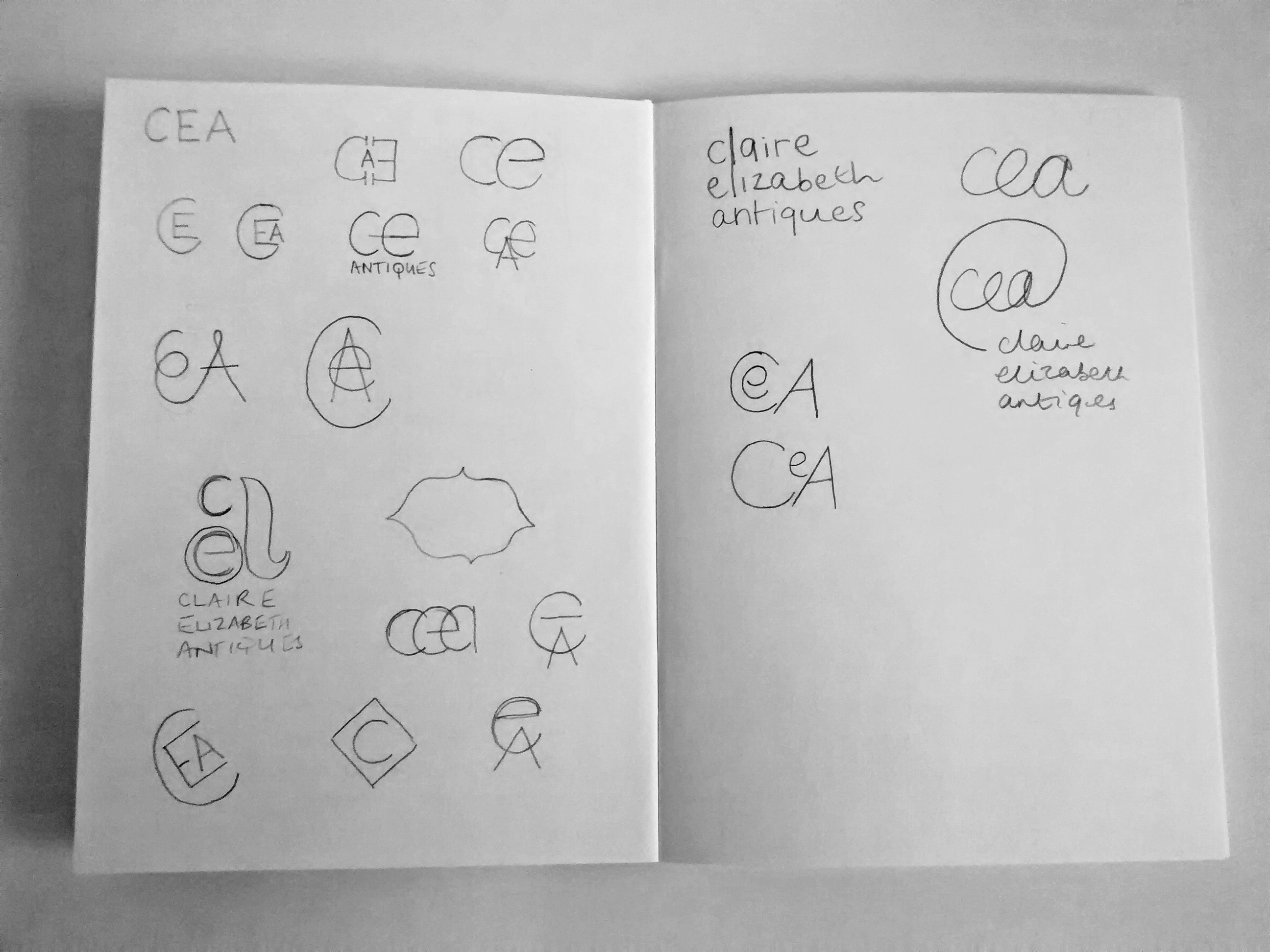
Concepts
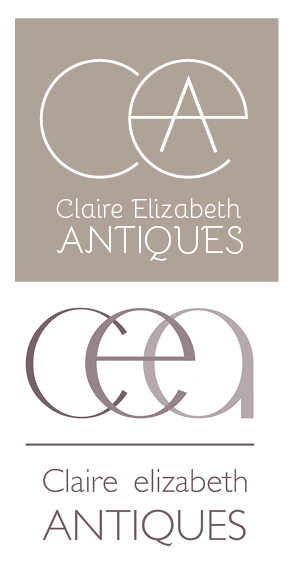
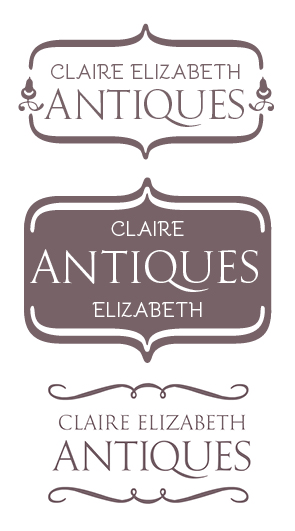
Concepts put simply are rough ideas of what the logo could look like, similar to an artist’s preliminary sketch before they put paint onto a canvas. Whilst I work on the client’s concepts, I would also research current design trends and look at how other similar businesses are presenting themselves. On most jobs I will normally present two or three concepts to a client. For some clients it’s hard to understand that although they look finished these are still at an early stage. With Claire’s logo I presented a selection concepts, and she felt that the first option (see below, concept 1) best represented her brand. We then discussed where it needed refining, such as altering colours, revising fonts, sizes, etc.
Revisions
After presenting the concepts, I would go away and make the changes we had discussed, and then supply Claire with the revised concept. This is where any final tweaks are made, or if the client is happy, I prepare the final logo artwork.
Final Artwork
This is the last stage of the process. Here I check kerning (spacing between lettering), alignment, correct colours (print uses a different colour process, CMYK, to digital’s RGB). Once I’m happy with it, I will then supply the client with logo artwork suitable for use in print for items such as business cards, letterheads, flyers, posters and shop signage or for digital use on social media (such as Twitter, Facebook & Instagram) and their company website.

WEBSITE DESIGN & BUILD
Briefing
As with the logo, this is where we discuss requirements, inspiration, competition and also look at the client’s existing site if they have one. In Claire’s instance, being a new and fairly small business, we felt it would be overkill for a large showy website, and obviously the budget will also dictate what is achievable. These days it’s expected that a website is responsive, in that it scales and re-arranges itself for different sized devices. We felt this took priority – with many users now relying on their smartphone for web use, we wanted to ensure customers could do this comfortably with Claire’s website. At this stage of the process, I really want to get to the crux of the website needs, so I would quiz the client on the following:
- Do they have a current website or any old websites from the past?
- Do they use Facebook or Twitter for business use?
- Have they bought a domain name? If not, discuss best name options.
- Do they currently have any website hosting packages in place? If not, discuss the best option for their needs.
- Do they have an online shop, or sell through any third parties, like eBay?
- Do they need a blog?
- Do they have any specific photography requirements?
- Do they need a contact form?
- What short term, and long term goals do they have for their shiny new website?
Once my client and I have worked through this list (and there are plenty more questions that can be added!) I have a pretty good idea of the required structure and functionality of the site, and how many page templates their website might require.
Concepts
Similar to the logo design process, I take this opportunity to look at other websites for style, format and content. I then design a concept to present to the client – in most cases I may show a mock up of a website home page and some content pages, such as the ‘About’ page and ‘News’ (aka blog) page. In Claire’s case, we felt that an elegant one-page website sufficed, as we wanted to keep it simple. We clearly divided the page into sections – ‘Welcome’, with a large image of her shop and below a headshot. Followed by a small section of copy about her, then a section titled ‘The Showroom’ which consists of a grid of images showcasing some examples of her stock, a list describing the items she stocks and then a link to a large online antiques auction site that she uses to sell online. Finally the last section of the site is a contact form that enables any potential customers to contact Claire if they have any queries.
Revisions & build
This is where the bulk of the work takes place. Once myself and the client are happy with the designs, these will get sent to a web developer (coder). In this part of the process there will be a bit of ‘to-ing and fro-ing’ between myself (the designer), the web developer and the client. Naturally as the website starts to take shape, there may be some items of the design that might not be working, so this is where you can iron out any teething problems. There is also testing on various devices, and on a variety of web browsers such as Chrome, Firefox and Safari.
Going live
Once we are all happy that the site is looking how we envisaged, we can organise the hosting, and get everything pointing to the right place in terms of domain names and email addresses. When everything is in place, we can ‘flick the switch’ to go live. But it doesn’t end there! This is when we start to closely monitor performance, using Google Analytics, check how the site is doing in terms of SEO (Search Engine Optimisation), and also keep tabs on any customer feedback that comes in. A website is an ongoing project, where any changes can have instant results, and it’s good to plan in some time to keep it in shape. Naturally, Pick Me! Design can be on-hand to help out with this going forward.
“It was an absolute pleasure working with Sarah to create a logo and website for my antique business. Sarah carefully evaluated my needs in a very organised and professional manner. She grasped exactly what I wanted perfectly and any modifications I wanted were done quickly and efficiently. Sarah is very creative and offers excellent customer service. I would highly recommend Sarah. I’m delighted with the whole experience.”
Claire Naveira, Claire Elizabeth Antiques, Reigate, Surrey